


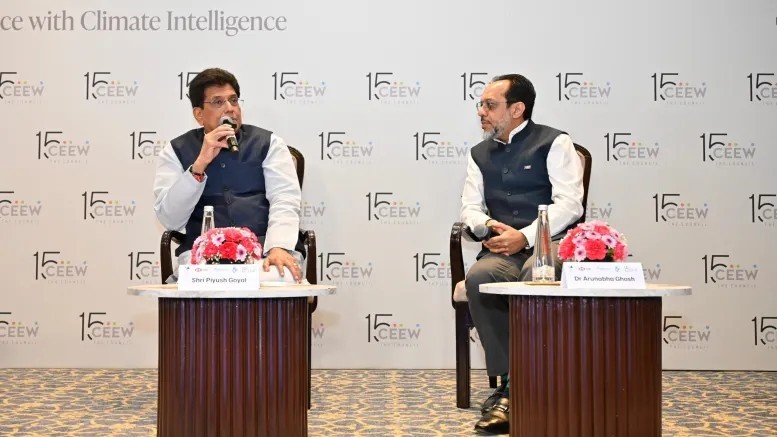
With 260 GW of clean energy already installed and a 500 GW target for 2030, India is combining climate leadership with wider global trade partnership
New Delhi
Union Commerce and Industry Minister Piyush Goyal on Wednesday highlighted India’s strong performance in climate action, stating that the country has emerged as one of the best-performing nations globally.
Having already surpassed its renewable energy targets ahead of schedule, India is now setting its sights on achieving 500 gigawatts of clean energy capacity by 2030.
Speaking at the ‘Advancing Resilience with Climate Change’ dialogue, Piyush Goyal emphasized that India has consistently ranked among the top performers in the G20 when it comes to fulfilling its Intended Nationally Determined Contributions (INDCs). He noted that the country’s proactive approach and policy initiatives have enabled it to make significant progress in reducing emissions intensity and expanding renewable energy capacity.
The minister recalled that India initially planned to install 20 gigawatts of solar capacity over a period of nearly a decade. However, after the government led by Prime Minister Narendra Modi assumed office in 2014, the target was significantly scaled up to 100 gigawatts. According to Goyal, this ambitious goal was successfully achieved within the stipulated timeframe, demonstrating India’s commitment to sustainable development.
Building on this momentum, India has now set a much larger target of achieving 500 gigawatts of clean energy capacity by 2030. This includes a mix of solar, wind, and other renewable energy sources, aimed at reducing dependence on fossil fuels and ensuring energy security. The move is also expected to position India as a global leader in green energy transition.
Goyal also highlighted India’s pivotal role during the Paris COP21 climate summit. He stated that under Prime Minister Narendra Modi’s leadership, India played a key role in bringing together developed, developing, and least-developed countries to reach a consensus-based agreement. The approach allowed nations the flexibility to set their own climate targets while collectively addressing global warming. The minister added that India has successfully transformed its global image from being perceived as a reluctant participant in climate discussions to becoming a proactive leader in sustainability efforts.