


Intro
A recent drone strike near Ukraine’s Chornobyl nuclear facility has reignited fears over safety risks at the site of the world’s worst nuclear disaster, as officials race to repair damage amid ongoing conflict.
Chornobly
Denys Khomenko, a senior technical official at the Chornobyl Nuclear Power Plant, recalls the tense moment when a Russian strike drone pierced the protective structure shielding the damaged reactor. Despite the severity of the incident, Khomenko remained composed, emphasizing that calm decision-making is essential in managing such a high-risk environment.
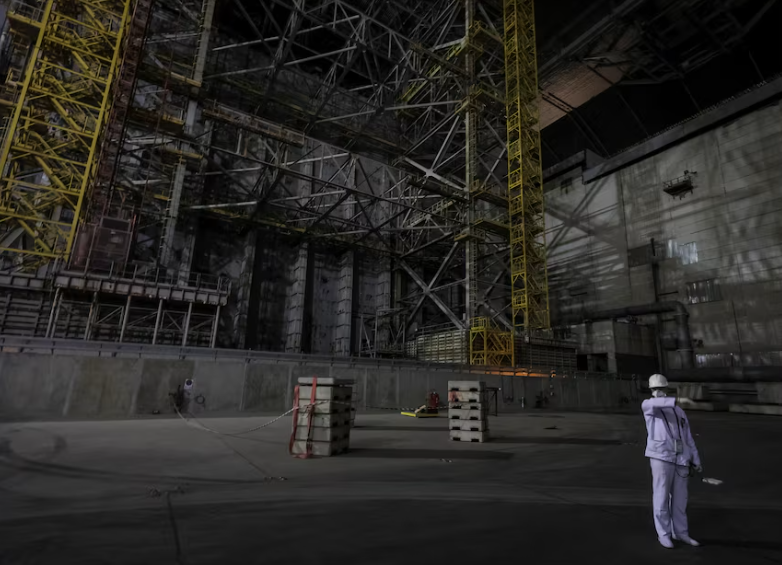
The facility, located about 100 kilometers north of Kyiv, continues to operate under strict safety protocols as it undergoes gradual decommissioning nearly four decades after the catastrophic Chernobyl disaster. The strike narrowly avoided a larger crisis, but it left a visible breach in the massive steel structure encasing reactor four.
Workers have temporarily sealed the hole using a large panel, though the scale of the protective arch—spanning 256 meters—makes repairs complex and time-consuming. The surrounding exclusion zone, while partially stabilized with near-normal radiation levels in some areas, still contains highly contaminated sections, particularly around the destroyed reactor core.
Khomenko explained that repair efforts are severely constrained by radiation exposure limits. Skilled workers such as welders can only operate for short periods—sometimes just minutes—necessitating a larger workforce that is currently difficult to assemble. This challenge underscores the ongoing vulnerability of the site amid continued military activity in Ukraine.
The situation is further complicated by the broader conflict, which has seen repeated air strikes on infrastructure across the country. The Chornobyl site itself was briefly occupied by Russian forces during the early stages of the 2022 invasion, delaying long-term dismantling plans for the damaged reactor.
The February 2025 drone strike triggered a fire that burned for weeks, damaging the outer membrane of the containment structure originally built to secure radioactive debris. Experts warn that the protective system, constructed in 2016 at a cost of approximately 2 billion euros and designed to last a century, now requires urgent repairs to prevent long-term deterioration.
As Ukraine prepares to mark the 40th anniversary of the disaster on April 26, the renewed threat highlights the enduring dangers posed by the site. With wildlife reclaiming nearby abandoned areas such as the ghost town of Pripyat, the contrast between natural recovery and persistent nuclear risk remains stark.