


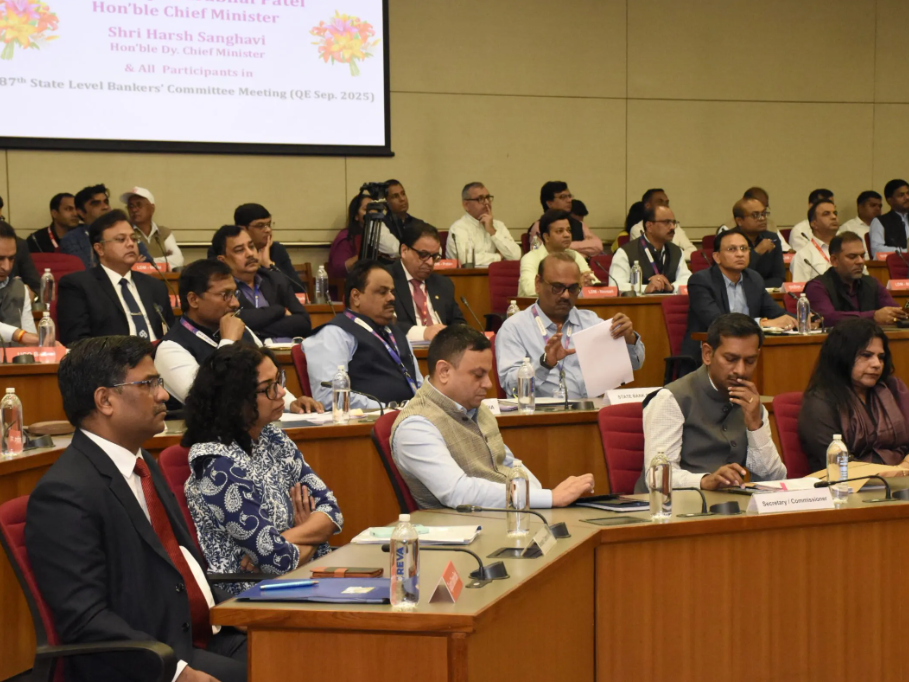
Gujarat Deputy Chief Minister Harsh Sanghavi hailed Jan Dhan Yojana’s banking revolution while urging stronger cybersecurity collaboration across sectors.
Ahmedabad
Gujarat Deputy Chief Minister Harsh Sanghavi on Tuesday emphasised that the Pradhan Mantri Jan-Dhan Yojana (PMJDY) has triggered an unprecedented transformation in India’s banking sector, making financial services accessible to every citizen rather than a privilege for the affluent. Speaking at the 187th meeting of the State Level Bankers’ Committee (SLBC) in Gandhinagar, he credited Prime Minister Narendra Modi’s vision for reshaping the country’s financial inclusion landscape.
Sanghavi highlighted that Gujarat has emerged as a frontrunner in establishing robust banking infrastructure. The state currently hosts more than 11,000 bank branches, with over 56 per cent situated in rural regions. This extensive network has enabled the opening of more than 1.75 crore Jan Dhan accounts, ensuring that even economically vulnerable households are firmly integrated into the formal banking system.
Turning to challenges posed by the digital era, Sanghavi underlined cybercrime as one of the most serious threats facing the financial sector. He noted that every cybercrime reported to Gujarat’s 1930 helpline resulted in a complete freeze of fraudulent transactions, due to rapid coordination between police and partner banks. To strengthen this response further, he urged banks to deepen cooperation with law enforcement and announced the formation of a joint committee comprising the Home Department, Gujarat Police and bank nodal officers to accelerate action against online fraud.
Sanghavi also recounted a recent incident involving Ahmedabad-based bank manager Jayesh Gandhi, who intervened to stop a senior citizen from losing Rs 45 lakh in a digital arrest scam. The Deputy CM said such vigilance and empathy among bank staff could play a significant role in curbing cybercrime.
Chief Secretary Manoj Kumar Das applauded banks for their role during the economic challenges of the Covid-19 pandemic and encouraged them to extend similar commitment to ongoing initiatives such as the SVAMITVA scheme.