


BLURB: The military activities are taking place against the backdrop of the continuing conflict in Ukraine
Moscow
Russia on Thursday intensified its military signalling toward the West by delivering nuclear munitions to facilities in Belarus and showcasing elements of its strategic nuclear forces during large-scale military exercises.
The Russian defence ministry announced that nuclear munitions had been delivered to field storage facilities connected to a missile brigade stationed in Belarus as part of ongoing nuclear force exercises.
The large-scale drills, described as some of Russia’s most significant nuclear exercises in recent years, involve around 64,000 military personnel and are focused on preparing and using nuclear forces in the event of external aggression.
During the exercises, Russia displayed several strategic military assets, including a Borei-class nuclear-powered ballistic missile submarine, Il-38 anti-submarine aircraft, MiG-31 fighter jets armed with Kinzhal hypersonic missiles, and RS-24 Yars intercontinental ballistic missiles. The exercises also involve Russia’s Strategic Missile Forces, the Northern and Pacific fleets, long-range aviation units, and military formations from the Leningrad and Central military districts.
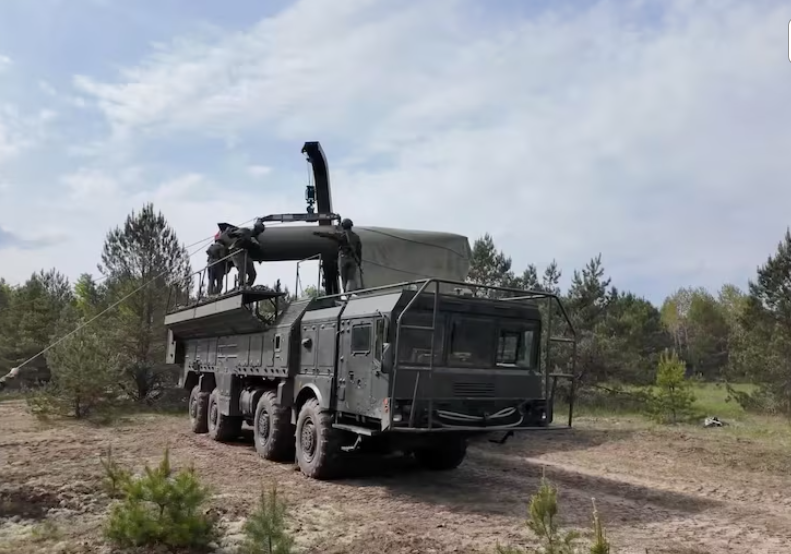
According to the Russian military, a missile unit in Belarus is also practising the handling and loading of special munitions for the mobile Iskander-M tactical missile system. Although Russian nuclear drills typically use dummy warheads for training purposes, the public display of strategic weapon systems is being viewed as a strong message directed toward NATO and Western governments.
Videos released by the Russian defence ministry showed military vehicles transporting equipment, as well as submarines, aircraft, and warships participating in the drills. The exercises, which began on Tuesday across Russia and Belarus, are scheduled to continue for three days.
The military activities are taking place against the backdrop of the continuing conflict in Ukraine, which Moscow has repeatedly described as an existential confrontation with the West.
Since the beginning of the war, Russian President Vladimir Putin has frequently highlighted Russia’s nuclear capabilities while warning Western nations against expanding military support for Ukraine. Kyiv and several Western leaders have criticised such statements, accusing Moscow of using nuclear threats to intimidate its opponents.
At the same time, tensions have increased in the Baltic region. Russia has accused Baltic nations of allowing Ukrainian drones to cross their airspace to attack northern Russian territory, claims that NATO has denied. Baltic countries, which strongly support Ukraine, argue instead that Russia is redirecting Ukrainian drones into their airspace.
The Kremlin also reacted sharply to comments made by Lithuanian Foreign Minister Kestutis Budrys, who said NATO must demonstrate its ability to penetrate Russia’s Kaliningrad exclave if necessary.
Moscow described the remarks as dangerous and irresponsible, further underscoring the strained relations between Russia and NATO as the conflict in Ukraine continues.