


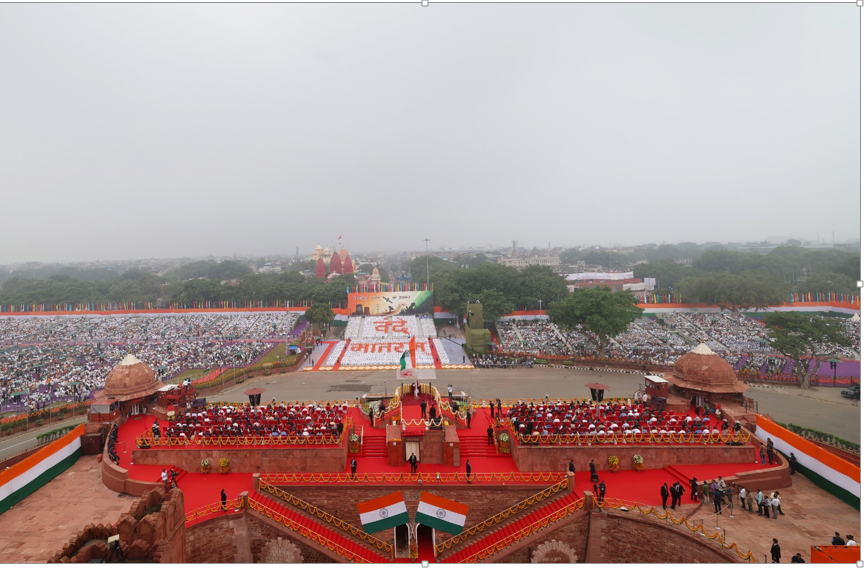
New Delhi
The aspirations of Gen Z and the power of ‘Yuva Shakti’ were at the heart of Prime Minister Narendra Modi’s Independence Day speech on Saturday, close on the heels of the massive student strikes post NEET paper leaks that snatched one of his ministers.
From a seven-point ‘Saptdhara’ reform framework to a caution against a new threat called “dimaagi naxal”, the PM used his address from the ramparts of the historic Red Fort in New Delhi to highlight both the opportunities and challenges faced by the country as it hurtles towards the goal of a ‘Viksit Bharat’ by 2047.
Delivering his 13th consecutive Independence Day speech, becoming the second PM after Jawaharlal Nehru to achieve the milestone, Modi reiterated his ‘Atmanirbhar Bharat’ push, sportlighting civil defence reforms, expansion of semiconductor manufacturing and new targets for nuclear power generation as core areas.
Another strongest message was on women’s representation in policymaking. Amid the impasse over the women’s quota bill, Modi appealed to the opposition to set aside differences and ensure 33% reservation for women in Parliament and assemblies.
Takeaways from PM Modi’s I-DAY speech
1. Youth outreach
A major theme of PM Modi’s speech, which lasted for around 75 minutes, was the country’s youth, as he announced a slew of initiatives to win over Gen Z.
> AI skill training for youth: A nationwide artificial intelligence skilling programme targeting 1 crore (10 million) young citizens over the next year to boost future employability.
> Free online coaching: Free digital coaching support for students and aspirants preparing for various competitive examinations to ease financial burdens on families.
2. ‘Saptdhara’ vision
Modi also unveiled a seven-point ‘Saptdhara’ roadmap as a new framework for building a ‘Viksit Bharat’, drawing a parallel with the ancient reference to the ‘Sapta Sindhu’, or seven rivers.
- Manufacturing power: To make India a trusted global hub for manufacturing, from components to finished products.
- Agriculture and food: To take desi products like millets, spices and fruits to global markets while urging farmers to make India a global food powerhouse.
- Technology & Innovation: Modi identified AI, quantum technology, space, and robotics as areas where India must build capability and become an innovation hub, rather than merely a market for the world.
- Gati Shakti: Fast connectivity across cities through high-speed rail and modern highways was the need of the hour, PM Modi flagged in his I-Day speech.
- Defence Power: Self-reliance in defence was another clear priority, PM Modi said, coming weeks after India marked the first anniversary of Operation Sindoor. The Prime Minister called for becoming a global supplier of next-gen defence technologies, with focus on drones, hypersonic technology and cybersecurity.
- Energy security: PM Modi asserted that India aimed to start five nuclear reactors in the next decade, citing the need to strengthen energy security. “Our goal is to achieve 100 gigawatts of nuclear power capacity,” he said.
- Soft Power: Lastly, he called for leveraging yoga, Ayurveda, and India’s rich culture to boost the country’s global and diplomatic influence.
3.’Dimaagi’ Naxals
While highlighting India’s challenges, PM Modi warned of a new enemy – ‘dimaagi naxals’ (naxal mentality). The prime minister stressed that while the Naxals who took up arms have been eliminated, there were “dimaagi naxals” who were embedded in the corridors of power. “These ideological Naxals must be identified and isolated,” PM Modi said.
4. Women’s Reservation Bill push
With the government’s backchannel talks with the opposition over the women’s reservation bill, which it has linked to delimitation, coming a cropper, PM Modi used his Red Fort address to appeal for consensus. He urged parties to rise above politics and facilitate the implementation of the proposed 33% reservation for women in Parliament. “Take the credit yourselves, but give our mothers and sisters their due rights,” PM Modi said in his message to the opposition. Notably, none of the leaders of the opposition, Rahul Gandhi and Mallikarjun Kharge, attended the Red Fort ceremony.
5. Weaponisation of sea routes, fuel
In a sharp warning, PM Modi said some countries were weaponising resources and strategic sea routes. Citing the turbulent period during the peak of the Iran war, PM Modi underscored that self-reliance and diversification helped ensure India did not face petrol, diesel or LPG shortage. “The world is busy weaponising whatever it possesses – petrol, diesel, fertilisers, medicines, technology chips. Even territory is being weaponised… Every nation has shifted towards a mindset of looking after its own interests,” PM Modi said.
6. Sports talent hunt
Reiterating India’s ambition to host the 2036 Olympics, PM Modi used the occasion to announce a nationwide hunt to identify young sporting talent aged between 5-15 years. “They will get special training to become world-class athletes,” the Prime Minister said. He highlighted that India hosting the 2030 Commonwealth Games would be a stepping stone for the country to realise its Olympic dream.
Modi pushes India from arms buyer to arms builder
PM Modi on Saturday staked India’s claim on hypersonics, drones and counter-drone systems as the next frontier of military self-reliance, telling the country from the ramparts of the Red Fort that it must stop buying its way to security and start selling next-generation defence technology to the world. “There is no alternative to being self-reliant in defence,” he said. “When countries around the world are increasingly thinking about their own interests, Bharat cannot simply remain a market for the world.” Naming “Raksha Shakti” as one of seven streams of power that will carry the country to the government’s vision of a Viksit Bharat by 2047, Modi made a blunt case for bearing the costs of indigenisation. Foreign equipment may be cheaper and quicker to acquire, he conceded, but it builds nothing at home, he said.
In a historic first, Vande Mataram echoes from ramparts of Red Fort
For the first time in the Independence Day celebrations at the Red Fort, ‘Vande Mataram’ was rendered in full at the historic venue. The presentation was part of the celebrations marking 150 years of the national song, which has remained closely linked with India’s freedom struggle and patriotic history.