


BENGALURU
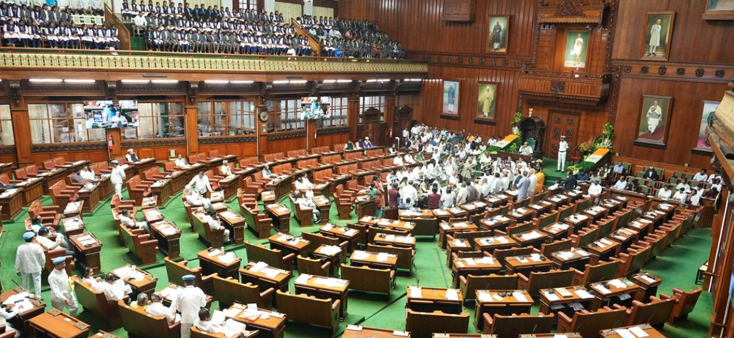
The monsoon session of the Karnataka Legislative Assembly has transformed into a theater of relentless political confrontation, marked by high-voltage protests, allegations of massive financial misappropriation, and the rapid passage of crucial legislative bills amidst a deafening cacophony.
The corridors of the Vidhana Soudha have been echoing with slogans, sit-ins, and deep-seated ideological clashes as the ruling government and the opposition lock horns over the fate of Planning and Statistics Minister B. Nagendra, alongside a slew of other pressing state issues.
What began as a standard legislative session to address the state’s governance, drought conditions, and welfare schemes quickly unraveled into a relentless war of attrition between the ruling Congress party and the combined forces of the Bharatiya Janata Party (BJP) and the Janata Dal (Secular) [JDS].
The Siege of Vidhana Soudha and the Walmiki Corporation Fallout
The primary catalyst for the legislative paralysis is the multi-crore scandal involving the Walmiki Development Corporation. The opposition has mounted an unyielding campaign demanding the immediate dismissal and resignation of Minister B. Nagendra. The controversy stems from the alleged illegal transfer and misappropriation of funds amounting to Rs 187 crore meant for the welfare of the Dalit and Walmiki communities.
The political friction reached a boiling point when the BJP and JDS launched a highly coordinated, unprecedented attempt to physically lay siege to the Vidhana Soudha. In a strategic maneuver, the opposition legislators and party workers mobilized into four distinct teams, launching their march from four different nerve centers across the city:
- Team One marched from Freedom Park, a traditional stronghold for democratic protests.
- Team Two advanced from the vicinity of the Raj Bhavan.
- Team Three mobilized from the Legislators’ Home (MLAs’ House).
- Team Four advanced from the Right to Information Commission office.
Their objective was to blockade the four main gates of the state secretariat. However, city police had anticipated the escalation. A formidable security ring, complete with heavy barricading, was established around the perimeter. Only personnel with valid identification were permitted entry. As the protesters, led by Leader of the Opposition R. Ashok and BJP State President B.Y. Vijayendra, aggressively tried to breach the security cordons, scuffles broke out. Police officers intercepted the marchers, forming human chains and detaining the leaders mid-route. Stray groups of workers attempting to bypass the blockades via the nearby metro station were chased and detained by authorities.
The opposition’s stance remains resolute. Former minister Raju Gowda, MLA Munirathna, and Legislative Council Opposition Leader Chalavadi Narayanaswamy held placards accusing the Congress of betraying the Walmiki community. They highlighted the tragic suicide note of the corporation’s Auditor General, P. Chandrasekaran, which originally blew the lid off the financial irregularities in 2024. The opposition argues that it is a profound constitutional and moral failure for a minister facing such severe allegations of embezzling marginalized community funds to retain his cabinet berth.
Chaos on the Assembly Floor
Inside the Assembly, the physical protests outside were mirrored by unprecedented disruptions. From the moment Speaker G.S. Patil convened the House, BJP and JDS MLAs abandoned their seats, surging into the well of the House and chanting anti-government slogans.
The standoff highlighted a stark contrast in the priorities articulated by the opposing factions. BJP MLA Sunil Kumar vehemently criticized the administration, calling it the most “blatant government” he had ever witnessed. R. Ashok echoed this sentiment, declaring an overnight, indefinite sit-in. “We will protest day and night in the House until he resigns. We will not let up for any reason,” Ashok declared, emphasizing that the illegal transfer of Dalit funds could not be swept under the rug.
Conversely, the ruling benches accused the opposition of hijacking democracy and ignoring the genuine crises gripping the state. Deputy Chief Minister Dr. G. Parameshwar expressed deep frustration, pointing out that vital issues, including severe agrarian distress and the Bidadi problem, were being neglected. “The opposition parties are not interested in discussing burning issues,” he noted.
Bangalore Urban Development Minister Krishna Byre Gowda brought the focus back to the severe drought plaguing the state due to a critical lack of rainfall. He lambasted the opposition for wasting precious legislative time while farmers remained in profound distress.
Minister Priyank Kharge took a more combative approach, challenging the BJP to a structured debate equipped with documentary evidence, claiming the opposition was engaging in performative politics rather than substantive parliamentary discussion. Excise Minister Shivalinge Gowda also mounted a strong defense, stating, “There are thousands of people who are accused. The moment they make allegations, they do not become criminals. There are 150 ministers in the country who are accused. You are well-practiced and are shouting.”
Despite the cacophony, Speaker G.S. Patil firmly pushed forward with the official business, allowing reports to be submitted and navigating through the Question Hour amidst relentless sloganeering.
The Alleged Media Blackout
Adding another layer of controversy to the session was a formal complaint lodged by R. Ashok regarding an alleged media blackout. In a strongly-worded letter to Speaker G.S. Patil, Ashok accused the state Information Department of partisan discrimination.
He alleged that since the monsoon session commenced on August 13, the live feeds, photographs, and video statements of opposition leaders were deliberately being withheld from print and visual media outlets. He claimed that the cameras actively avoided the opposition benches when they were raising crucial public issues, exclusively focusing on the Chief Minister, cabinet ministers, and ruling party members.
Ashok warned of moving a motion of disqualification against the concerned Information Department officials if the broadcast feeds were not immediately democratized to reflect the proceedings of both sides of the aisle equally.
Legislative Overdrive: Passing Key Bills in the Din
In a controversial move that drew the ire of the opposition, the government utilized the ongoing chaos to pass a total of eight crucial legislative bills without comprehensive debate. The bills, which carry significant implications for the state’s urban planning, environmental conservation, and commercial sectors, were introduced, analyzed by ministers, and approved via voice vote while opposition MLAs protested in the well.
The key pieces of legislation passed include:
- The Karnataka Government Parks (Conservation) (Amendment) Bill, 2026: Undoubtedly the most contentious of the lot, this bill allows the state government to alienate up to 5% of the total area of government parks for public utility projects through sale, lease, gift exchange, or mortgage. Deputy Chief Minister Parameshwar clarified that this alienation is strictly restricted to statutory authorities, government companies, or local authorities, and requires evaluation by an expert committee headed by the Additional Chief Secretary. However, R. Ashok heavily criticized the move, warning that the Congress government was paving the way to destroy green spaces, citing fears that 10 acres of the historic Lalbagh Botanical Garden could be compromised.
- Bengaluru Metropolitan Land Transport Authority (Amendment) Bill, 2026: Introduced by Krishna Byre Gowda, this bill aims to create a unified framework to tackle Bengaluru’s infamous traffic congestion and modern transportation challenges.
- Karnataka Registration of Goods and Services (Amendment) Bill 2026: Aimed at curbing illegal property registrations in urban areas, this legislation demands due diligence from Sub-Registrar Officers, simplifies the public registration process to avoid delays, and introduces severe penalties for hacking or tampering with the department’s software portals.
- Karnataka Gram Swaraj and Panchayat Raj (2nd Amendment) Bill 2026: Rural Development Minister Eshwar Khandre piloted this bill to address the rampant proliferation of unauthorized buildings and illegal land conversions in villages. The bill introduces a mechanism to levy and collect property taxes on these unauthorized structures, aiming to boost the revenue net of rural administrative bodies.
- Karnataka Industries (Facilities) (Amendment) Bill, 2026: Piloted by MB Patil, this bill establishes a State Nodal Agency to streamline industrial setups. It elevates the Deputy Chief Secretary and Development Commissioner to head the State Level Authorized Committee and replaces traditional acceptance certificates with an affidavit-based consent system to improve ease of doing business.
- Karnataka Shops and Commercial Establishments (Amendment) Bill 2026: Introduced by Labor Minister Santosh Lad, this bill modernizes fee payments through digital mediums and allows for the appointment of a subpoena for the conciliation of offenses and appeals.
- Karnataka Land Revenue (Amendment) Bill, 2026: This bill introduces stringent provisions against the creation of duplicative documents, misrepresentation, and fraud, redefining the legal standing of bona fide copies.
Dissatisfaction over the rushed legislative process was palpable. MLA Basanagouda Patil Yatnal expressed deep frustration during Zero Hour, pointing out that crucial issues—such as relief for Krishna river flood victims, the severe state drought, farmer protests against land acquisition, vacant government posts, and the KPSC recruitment scam—were completely ignored. He accused the opposition of compromising with Chief Minister D.K. Shivakumar and demanded an extension of the House schedule to address these pressing public matters.