


Judge never retires
Jaipur
Chief Justice of India Surya Kant on Saturday underscored the enduring value of retired judges, comparing them to traditional stepwells that sustain communities during difficult times.
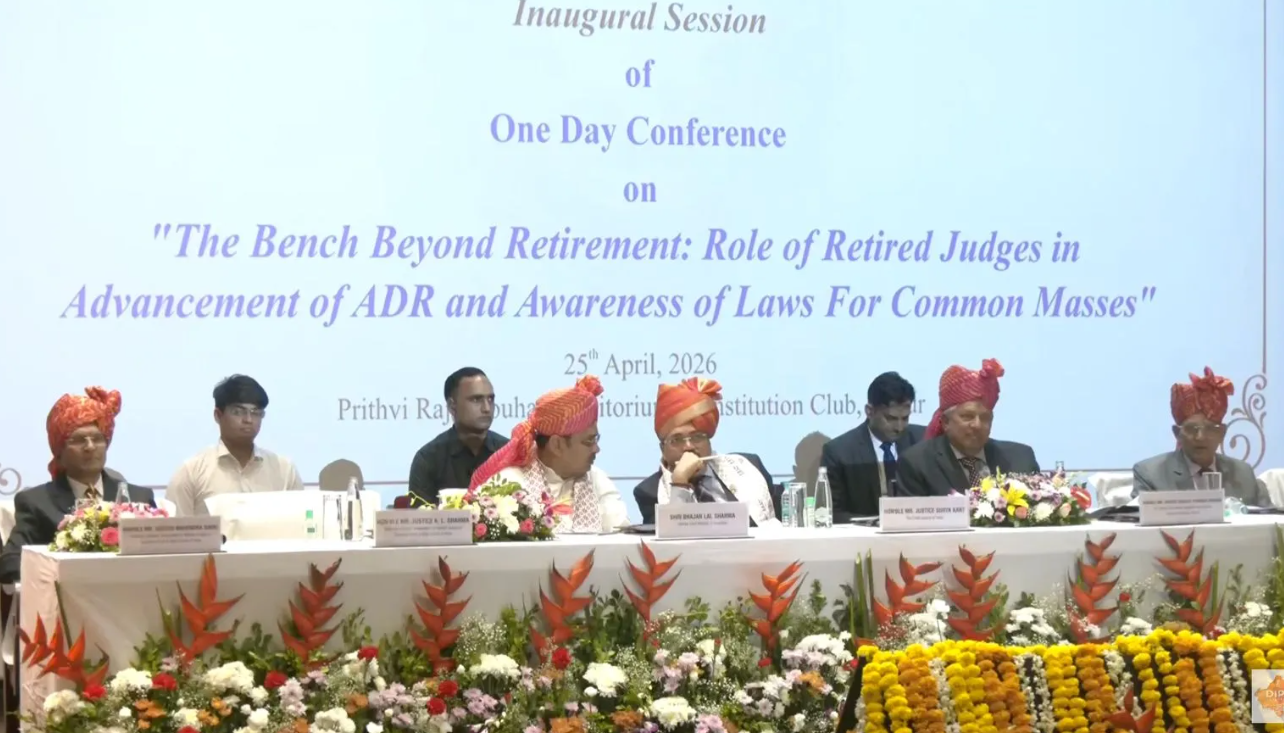
Speaking at a seminar in Jaipur, he highlighted the need to better utilise their experience to strengthen the judicial system.
Addressing a one-day seminar titled The Bench Beyond Retirement, the Chief Justice drew a powerful analogy from the arid regions of Rajasthan, where stepwells, locally known as bawris, act as crucial water reserves during droughts.
Referring to his roots in Churu, he explained how these structures collect rainwater over time and provide sustenance when resources run scarce. He said retired judges play a similar role during periods of institutional stress, offering guidance, wisdom, and stability.
CJI Surya Kant stressed that the legal system often underestimates the value of former judges after retirement. He remarked that while farewell ceremonies acknowledge their contributions, the system tends to move on without effectively leveraging their expertise. A judge never truly retires. Once a judge, always a judge, he said, emphasizing that their knowledge cannot be replaced by committees or training programmes.
He highlighted that judges carry not only a deep understanding of law but also insights into human experiences. Over years of service, they witness diverse societal challenges, from the struggles of rural farmers to the concerns of entrepreneurs and families in distress. This accumulated understanding, he noted, makes them uniquely equipped to contribute meaningfully even after retirement.
Calling the trust built by judges over decades a national resource, the Chief Justice warned that failing to utilise it amounts to a loss for society. He proposed a more structured role for retired judges, identifying four key areas where they could make a difference. These include serving as mediators and arbitrators to resolve disputes efficiently, acting as legal educators to spread awareness about rights, working as pre-litigation counsellors to prevent prolonged legal battles, and mentoring young professionals as institution builders.
He added that retired judges could play a vital role in strengthening alternative dispute resolution mechanisms such as Lok Adalats, which aim to reduce the burden on courts. By sharing their experience and institutional knowledge, they can help create a more accessible and efficient justice delivery system.
The remarks have sparked discussion within legal circles about how best to integrate retired judges into the judiciary’s broader framework. As the judicial system continues to face increasing caseloads and complexity, the Chief Justice’s suggestions point toward a more inclusive approach that values experience as a continuing asset rather than a concluded chapter.