


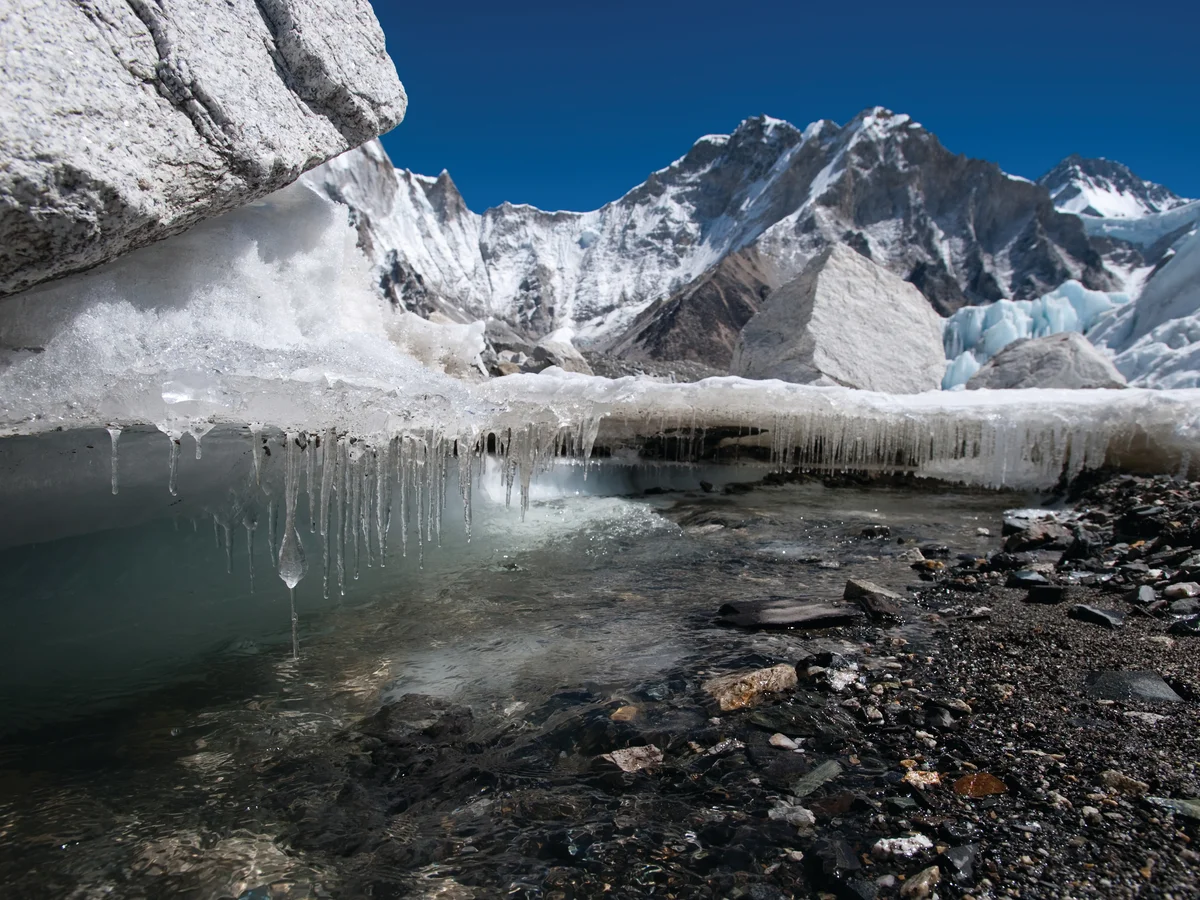
The Himalayas, often called the Third Pole due to their vast ice reserves, stand as Earth’s highest mountain range and home to the largest concentration of glaciers outside the polar regions. Stretching across 2,400 kilometers through five countries India, Nepal, Bhutan, China, and Pakistan these majestic peaks are experiencing unprecedented changes as global temperatures continue to rise. The accelerating impacts of climate change on this critical region carry profound implications not just for the mountain communities who call it home, but for the nearly two billion people downstream who depend on its waters for survival.
The Accelerating Crisis of Glacial Retreat
The most visible and alarming manifestation of global warming in the Himalayas is the rapid retreat of glaciers. Scientific studies have documented that Himalayan glaciers are melting at extraordinary rates, with some research indicating they are losing ice mass nearly twice as fast in recent years compared to the period before 2000. This acceleration represents a dramatic shift in the region’s cryosphere, with glaciers that have existed for millennia now shrinking at rates that would have seemed impossible just decades ago.
The mechanics of this glacial retreat are complex but fundamentally driven by rising temperatures. As average temperatures in the Himalayan region increase—warming at rates significantly higher than the global average—the equilibrium line altitude, where glacier accumulation balances ablation, shifts upward. This means that more of each glacier’s surface area experiences net melting rather than snow accumulation. The darker surfaces exposed as snow cover diminishes absorb more solar radiation, creating a feedback loop that further accelerates melting.
The consequences of this glacial loss extend far beyond the mountains themselves. Himalayan glaciers feed seven of Asia’s great river systems, including the Ganges, Indus, Brahmaputra, Mekong, and Yangtze. These rivers sustain agriculture, provide drinking water, generate hydroelectric power, and support ecosystems across South and Southeast Asia. As glaciers shrink, the long-term water security of these river basins becomes increasingly precarious. While melting may temporarily increase river flows, the eventual depletion of these frozen reservoirs threatens to drastically reduce dry-season water availability, with catastrophic implications for food security and economic stability across the region.