


CH NEWS
KALABURAGI
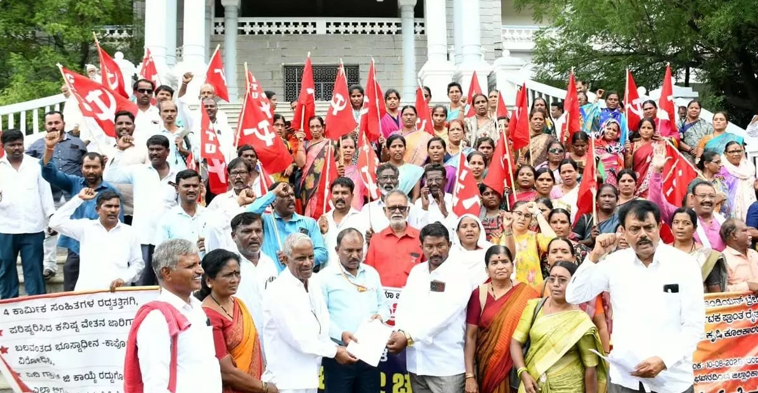
The Centre of Indian Trade Unions (CITU), along with the Karnataka Prantha Raitha Sangha (KPRS) and All India Agricultural Workers Union (AIAWU), staged a protest and Jail Bharo agitation, demanding immediate implementation of the final minimum wage notification and withdrawal of the four labour codes and the VB-RAMJI Act. The protesters said the State government’s final notification on minimum wages issued on May 22 was the result of decades of workers’ struggles. However, they claimed that the 60 percent increase in wages after nearly nine years was inadequate when compared with the rise in the cost of living over the past decade.They demanded that women workers, including Anganwadi workers, mid-day meal workers, ASHA workers and Gram Karya Mitras, who have been working for years, should also be brought under the minimum wage framework.
The protesters alleged that since the revised minimum wages have been made effective from May 22, 2026, instead of being applied retrospectively from 2022, nearly 1.77 crore workers in the State would lose the benefit of four years of wage revision. They demanded that the notification be implemented retrospectively to ensure justice to workers. Rejecting claims that higher minimum wages would force industries to move out of Karnataka, they said workers from other States were coming to Karnataka precisely because of better wages. Providing fair wages to workers would also have a positive impact on the State’s economy, they said.
They sought implementation of Minimum Support Price (MSP) for farmers based on the Swaminathan Commission recommendations, adequate crop insurance and farm loan waivers.
CITU President MB Sajjan, Sharanabasappa Mammashetty, Bhimashetty Yampalli, Meghraj Katare, Shanta Ghanti, Lavitra Vastrad, Prakash Bannigida, Kalyani Singe, Mahadev Singe, Ashok Bommanalli, Khajasab Nadaf, Kashinath Bandi, Shyamanna Reddy, Dileep Nagure, Nagayya Swamy and Sujatha Kadehalli were among those who participated.
The protesters alleged that the assurances given by the Union government during the farmers’ agitation that began at the Delhi borders in 2020 had not been fulfilled. Instead, several policies detrimental to farmers and workers were being introduced, they alleged. They warned that stronger protests would be launched if the State and Union governments failed to address the issues of workers, farmers and agricultural labourers.