


Mysuru:
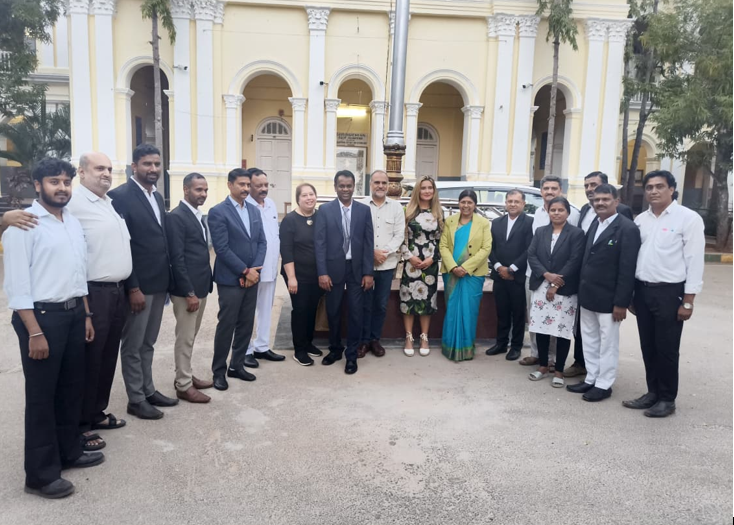
Members of Mysuru’s judicial fraternity had an opportunity to interact with a distinguished delegation from the International Court of Justice (ICJ), Netherlands, during its visit to the city’s Law Courts Complex and Malalawadi Court Complex in Mysuru.
The delegation comprised ICJ Judge Leonardo Nemer Caldeira Brant, his wife Joyce Costa and senior officials of the ICJ.
Principal District and Sessions Judge Usharani, DLSA Member-Secretary and Senior Civil Judge Nagaraj Siddappa Ankasadoddi, judges of various courts in Mysuru, Advocates’ Association President Lokesh S. and office-bearers of the association welcomed and felicitated the guests.
During the interaction, Justice Leonardo Nemer Caldeira Brant sought information about the Indian judicial system and the functioning of courts in Mysuru. He, in turn, shared insights into the role, functioning and proceedings of the International Court of Justice.
The interaction provided the Mysuru legal fraternity with a better understanding of international dispute resolution, the ICJ’s judicial functions and its role in the international justice system. The visit also facilitated an exchange of perspectives between the Indian judicial system and the world’s principal international court.
The delegation appreciated Mysuru’s rich cultural heritage, traditions and distinctive character during its visit.
The ICJ is the principal judicial organ of the United Nations, established under the UN Charter in 1945 and functioning from the Peace Palace in The Hague, Netherlands, since 1946. It primarily settles legal disputes between States under international law and gives advisory opinions on legal questions referred to it by authorised UN organs and specialised agencies.
The Court has 15 independent judges, each serving a nine-year term, with elections held every three years for five positions. Its official languages are English and French.
The ICJ handles two broad categories of proceedings—contentious cases between sovereign States and advisory opinions sought by authorised UN bodies and agencies. Its judgments are final and binding on the parties to the particular case, though the Court does not have a direct enforcement mechanism.
The Mysuru visit thus served as a valuable platform for legal professionals and judges to gain a deeper understanding of international justice and the functioning of the ICJ, while also strengthening professional and judicial interaction.