


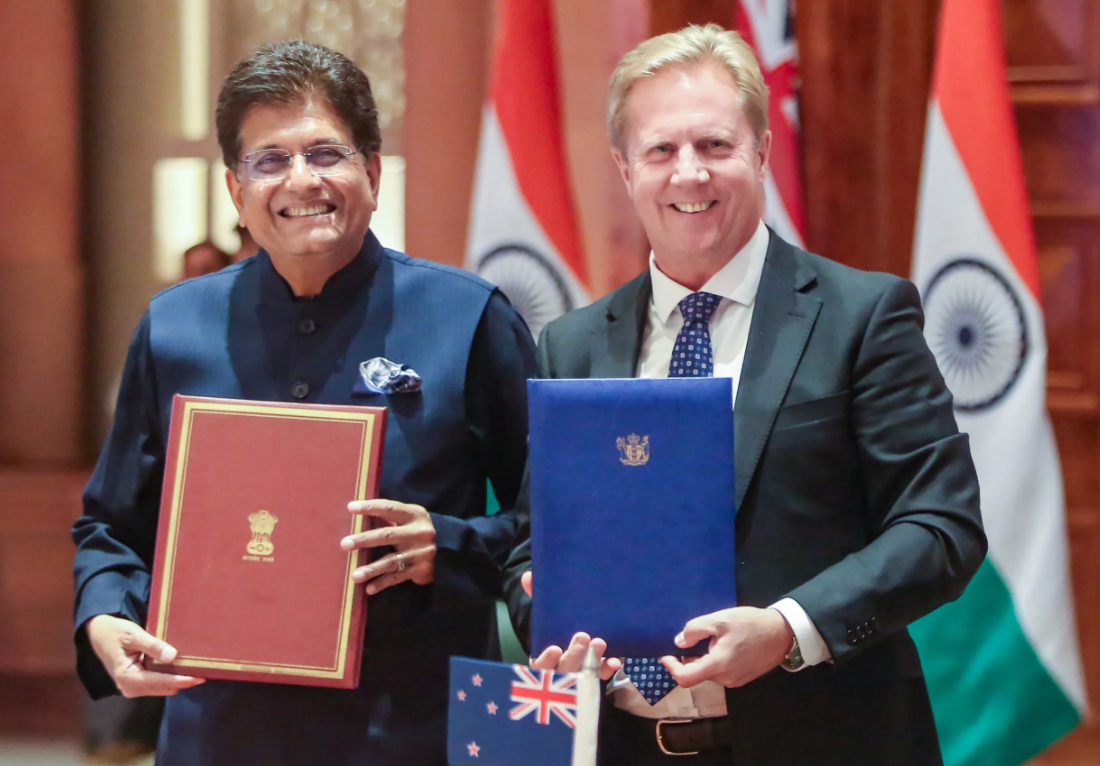
The recently concluded Free Trade Agreement (FTA) between India and New Zealand is being viewed internationally as a landmark step toward strengthening economic cooperation between the two democracies.
New Delhi
According to reports, the India-New Zealand FTA represents a major advancement in restoring balance to global trade following the tariff disputes triggered by U.S. President Donald Trump during his trade war policies.
Trade relations between India and New Zealand have steadily expanded over the last several years, and the newly signed agreement is expected to accelerate that growth significantly. Bilateral trade between the two nations increased from approximately $900 million during 2019-20 to nearly $1.3 billion in 2024-25. India’s exports to New Zealand recorded particularly strong growth, rising from $379 million to $711 million during the same period. Imports from New Zealand also increased, moving from $522 million to $587 million.
Although the overall scale of trade between the two countries remains relatively modest compared to larger global trading partnerships, analysts believe the structure and scope of the new agreement provide strong potential for sustained and long-term expansion. The agreement reflects growing economic interdependence and highlights areas where both countries can benefit through increased cooperation and exchange.
The historic agreement, eliminates tariffs on 100 percent of India’s exports to New Zealand. In return, tariffs on 95 percent of New Zealand’s exports to India will either be sharply reduced or completely removed. Experts say this will improve market access for businesses in both countries and encourage higher levels of investment and trade activity.
One of the most notable features of the agreement is New Zealand’s commitment to invest $20 billion in India over the next 15 years. The investment pledge has drawn comparisons to the $100 billion investment commitment offered by the European Free Trade Association in its own trade pact with India.
The FTA also places strong emphasis on mobility opportunities for students and skilled professionals. For the first time, New Zealand has signed a dedicated annex on student mobility and post-study work visas with another country. Under the arrangement, Indian students studying in New Zealand will be allowed to work up to 20 hours per week during their studies and will also benefit from extended post-study work visa opportunities.