


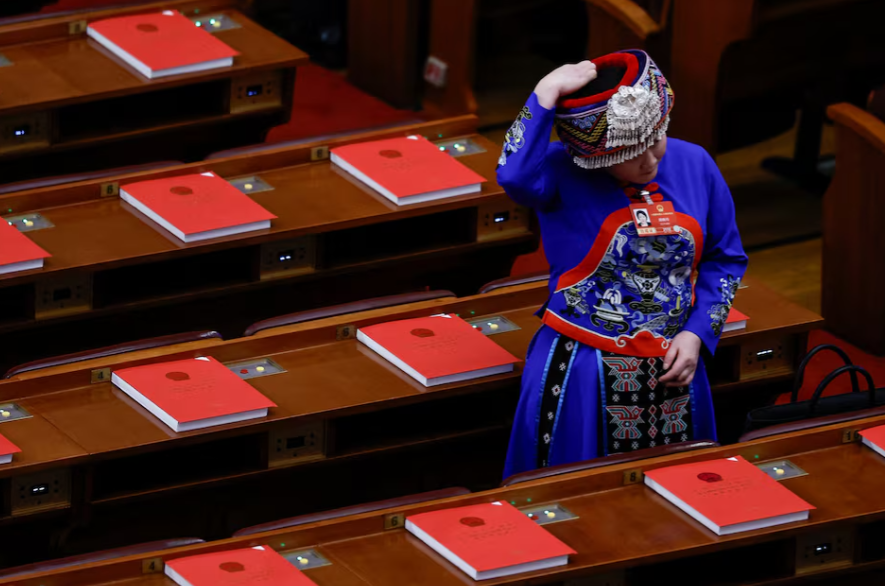
BLURB: China’s legislature passed a new law aimed at promoting a “shared” national identity among the country’s ethnic groups, a move the govt says will strengthen unity.
Beijing
The legislation, titled “Promoting Ethnic Unity and Progress,” was approved during the closing session of the annual meeting of the National People’s Congress, China’s top legislative body.
According to witnesses cited by Reuters, the law passed with overwhelming support, receiving 2,756 votes in favor, three against, and three abstentions.
A draft version of the law indicates that its primary objective is to strengthen national unity and advance what authorities describe as the “rejuvenation of the Chinese nation,” with the Chinese Communist Party (CCP) playing a central role. The legislation is scheduled to come into force on July 1, according to Chinese state media reports.
Chinese officials say the law is intended to promote solidarity among the country’s diverse ethnic communities and reinforce a unified national identity. However, critics argue that the policy may increase pressure on minority groups to assimilate into the dominant Han Chinese culture.
Some analysts also warn that the legislation could make it easier for authorities to label dissenting views or expressions of ethnic identity as separatism, potentially exposing individuals or groups to legal consequences under China’s strict national security framework.
China officially recognizes 56 ethnic groups within its population of roughly 1.4 billion people. The majority Han Chinese community accounts for more than 91 percent of the population, making it by far the largest ethnic group in the country.
The remaining 55 ethnic minorities include groups such as Tibetans, Mongols, Hui, Manchus, and Uyghurs. Many of these communities are concentrated in large autonomous or semi-autonomous regions that together cover nearly half of China’s total land area. These regions are also known to be rich in natural resources and strategically significant.
In recent years, China has implemented a range of policies aimed at strengthening national unity and integrating ethnic minority regions more closely with the rest of the country. Supporters say such measures are necessary to maintain stability and development, while critics argue they risk undermining linguistic, cultural, and religious traditions of minority communities.
The new law marks the latest step in Beijing’s broader effort to shape a unified national identity, a policy that continues to draw international scrutiny and debate.