


Shivamogga
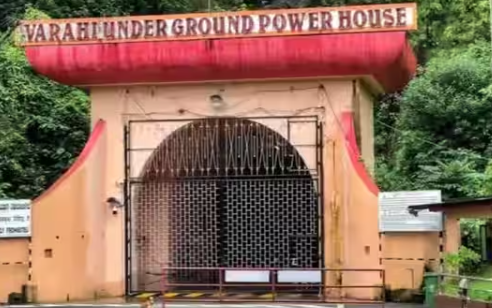
Karnataka’s Varahi hydroelectric project has earned a unique distinction as Asia’s first underground power generation station, built inside a mountain to overcome the challenge of inadequate water pressure for electricity generation.
The project was initially planned to generate power using water from the Mani and Pickup reservoirs. However, engineers found that the available water pressure would not be sufficient to operate the turbines at the required level and achieve the expected power generation. As a solution, an underground powerhouse was constructed near Hosangadi in Kundapur taluk.
The powerhouse is located about 78 metres below ground level. A massive underground cavern measuring 155 metres in length, 20 metres in width and 30 metres in height was excavated, creating nearly 93,000 cubic metres of space for the turbines. The pressure tunnels carrying water, tailrace tunnels, cables, ventilation passages and even a 700-metre access road are located underground.
The underground station has four units, each with a capacity of 115 MW, giving it a total capacity of 460 MW. It generates an average of about 1,100 million units of electricity annually. During 2025-26, the station recorded its highest-ever generation of around 1,600 million units.
The Varahi station is mainly operated as a peak-load power station rather than a base-load facility. It is used when electricity demand rises sharply, particularly during morning and evening peak periods. The first unit was commissioned on August 12, 1989, followed by the second on November 12, 1990. The third and fourth units began operations on January 3 and January 14, 2009, respectively. The project’s capacity was subsequently expanded from 230 MW to 460 MW. Two additional 4.5 MW units at the Mani dam take the total capacity of the Varahi project to 469 MW.
Varahi underground hydroelectric station overview
- Location & Structure: Situated 78 metres underground in a massive 155-meter cavern with comprehensive tunnels and a 700-meter access road.
- Capacity: Features four primary units totaling 460 MW, plus two 4.5 MW units at Mani dam, bringing total capacity to 469 MW.
- Power Generation: Generates an average of 1,100 million units annually, hitting a record 1,600 million units in 2025-26.
- Operational Role: Functions primarily as a peak-load power station to meet sharp morning and evening electricity demand spikes.
- Commissioning Timeline: Unit 1 launched on August 12, 1989; Unit 2 on November 12, 1990; Units 3 and 4 in January 2009.
- Capacity Expansion: Successfully doubled its original generation capacity from 230 MW to the current 460 MW output.