


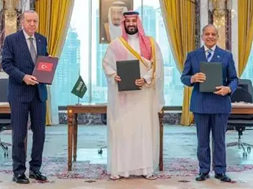
Intro: While focused primarily on defence and security, the country increasingly hopes the agreement will also bring economic benefits.
Islamabad
Pakistan is witnessing renewed optimism over the Makkah Joint Defence Agreement, with expectations that the pact could attract foreign investment, increase Saudi financial assistance, provide oil on deferred payments and create more employment opportunities for Pakistanis in Gulf countries, according to a report.
The agreement, involving Pakistan, Saudi Arabia and Turkey, came into force on August 7. Under the pact, an armed attack against any one of the three countries will be regarded as an attack against all three. While the agreement is primarily focused on defence and security, hopes in Pakistan have increasingly expanded towards potential economic benefits.
These expectations have been compared with the enthusiasm surrounding the China-Pakistan Economic Corridor, launched in 2015 and widely described at the time as a potential game changer for Pakistan’s economy. However, more than a decade later, the country continues to face debt pressures, weak exports, low productivity and recurring balance-of-payments problems.
An opinion article in Pakistan’s Dawn argued that the country has repeatedly placed hopes in external partnerships to overcome its economic difficulties. It suggested that while strategic agreements and foreign investment can provide support, they cannot replace domestic reforms needed to address structural weaknesses.
The report noted that Pakistan remains dependent on IMF programmes, financial deposits, loan rollovers and assistance from friendly countries, including China and Saudi Arabia. This dependence has strengthened the perception that external support is essential for economic stability.
The latest defence pact could improve Pakistan’s strategic position and deepen ties with important regional partners. However, the analysis cautioned against viewing it as a substitute for economic reforms, stronger institutions and sustainable domestic growth.
It argued that long-term prosperity would require improvements in governance, productivity, exports, political stability, peace, rule of law and democratic institutions. The report concluded that Pakistan’s future economic transformation will ultimately depend on what it achieves domestically rather than on expectations of external rescue.