


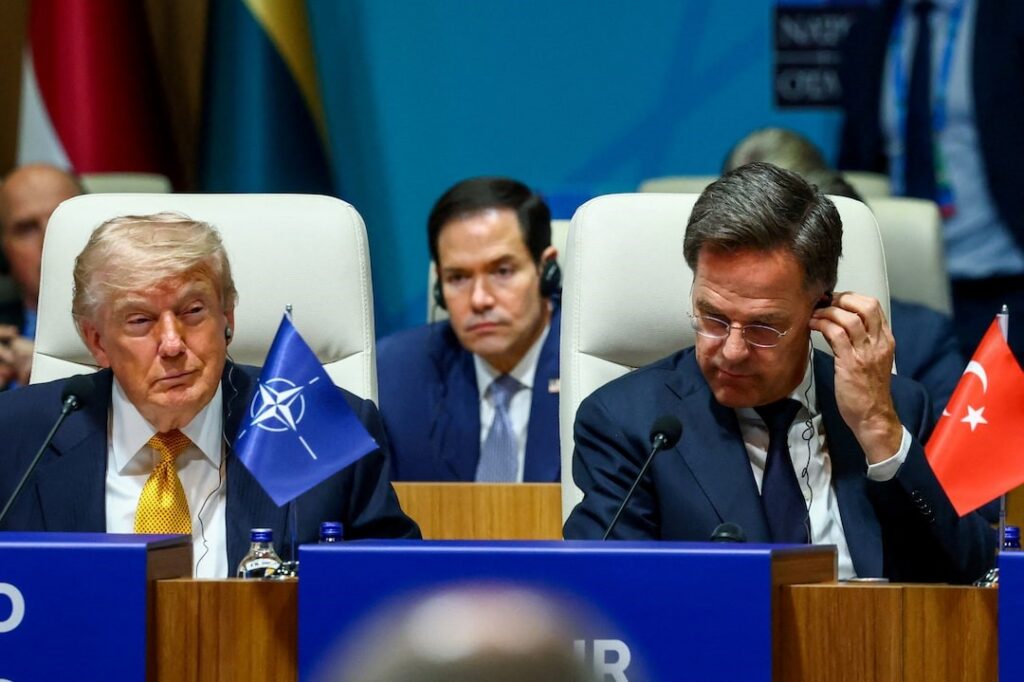
Ankara
NATO has weathered another storm from Donald Trump but European members of the military alliance are bracing for more turbulence ahead in relations with the U.S. president.
It says much about the state of U.S.-European ties when a NATO summit that began with a U.S. leader ordering a cutoff in trade with one member, Spain, and rebuking others was widely hailed as a success after he re-committed to the alliance hours later.
European leaders were upbeat after the Ankara summit, pleased by Trump’s talk of love in the room, his endorsement of a declaration that reiterated support for NATO’s Article 5 mutual defence pact and his decision to give Ukraine a license to make Patriot missile interceptors.
That was a relief after months of severe strains triggered by Trump’s efforts to take Greenland from fellow NATO member Denmark and divisions over the Iran war, which prompted him to revive his longstanding criticism of the alliance and cast doubt on future U.S. membership.
Although they expect more volatility in the relationship, European officials see huge value in keeping their superpower ally inside the alliance. Without U.S. military clout, many fear they would be more vulnerable to an attack from Russia.
There is, of course, one dominant player in the room – let’s be honest, NATO Secretary General Mark Rutte told Reuters after the summit.
The United States on its own is half of NATO’s economy, and the military might of the U.S. is unparalleled and is as big as the might of the rest of NATO combined.
Rutte said NATO’s credibility and ability to deter Moscow had not been undermined by the recent display of divisions. Not everyone is so sure.
Even if Trump makes nice, the damage is done, said Jim Townsend, a former senior Pentagon official now at the Center for a New American Security think tank.
Russia and the alliance taxpayer need to see that NATO is getting stronger, but that message is lost in the theatrics of Trump.
One European diplomat, speaking on condition of anonymity, doubted the summit had undone any of the damage of recent months. But it didn’t get worse and that’s progress, considering…, the diplomat said.