


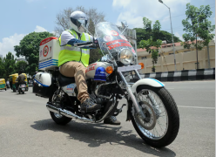
Blurb: Karnataka plans 100 new emergency response vehicles to provide quick treatment to patients
CH NEWS
BENGALURU
Bike ambulances, which were suspended due to lack of maintenance and poor response, will be back on the road. They will help in providing quick treatment to patients in metropolitan cities in case of emergencies.
These bike ambulances are operating in various parts of the country including Tamil Nadu and Maharashtra. This service was started in the state in 2015. At that time, 30 bike ambulances were introduced on an experimental basis. They operated in various parts of the state and provided services to thousands of people. Due to various reasons including maintenance problems, lack of repairs, and apathy of nursing graduates, one by one the bike ambulances were abandoned. The state government has now shown interest in introducing the bike ambulance service again and 100 bike ambulances will be operational soon.
Bike ambulances were introduced for the first time in the country in Bengaluru. The aim was to reduce the death toll due to road accidents and provide quick medical services amidst the traffic congestion. Patients and their families were reluctant to use the service as they were unable to take the patient to the hospital. Due to the increasing traffic congestion in various parts of the state including
Bangalore in recent years, it is becoming difficult for the ‘108 ambulance’ to reach the designated place in a short time in case of an emergency. According to the national standard, the time limit, golden hour, for an ambulance to take a patient to the treatment center is 20 minutes. Due to various reasons including traffic congestion, it is difficult to take a patient to the treatment center within this time limit. Therefore, priority is again being given to the bike ambulance. The time taken by the bike ambulance is 40 percent less compared to the ‘108 ambulance’.
In various cases including heart attacks and road accidents, immediate treatment can save a person’s life. There are examples where treatment has been delayed in some cases due to traffic congestion, further worsening the patient’s health. Bike ambulances can travel even on narrow roads and reach the designated location. Their maintenance costs are also low. Therefore, steps have been taken at the government level to reintroduce them, said a department official.
BOX
Bike ambulance equipment profile
A bike ambulance functions as a rapid-response paramedic unit designed to navigate congested traffic or inaccessible terrain. Its primary role is to stabilize a patient and deliver emergency care during the critical first hour (the “golden hour”) before a standard transport ambulance arrives. Because of space constraints on a motorcycle, the equipment profile is specific.
Diagnostics: Glucometer, portable blood pressure monitors, and heart rate monitoring equipment/pulse oximeters.
Respiratory support: Portable oxygen cylinder with flowmeters and airway management tools (like an Ambu bag).
Trauma & First Aid: Essential wound care, bandages, and basic life-saving drugs (such as coagulants, aspirin, or adrenaline).