


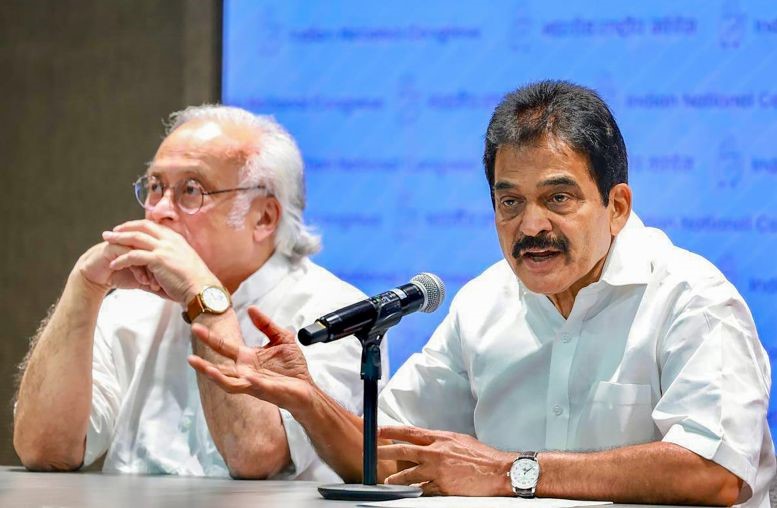
Blurb: Criticising the vice-chancellors for their participation in RSS event, the Congress leader questioned their institutional neutrality.
Thiruvananthapuram
Senior Congress leader KC Venugopal on Monday launched a sharp attack on three Kerala university vice-chancellors who attended an event linked to the centenary celebrations of the Rashtriya Swayamsevak Sangh (RSS), demanding their immediate resignation and accusing them of compromising the secular character of higher education institutions.
The controversy arose after the vice chancellors of University of Kerala, Mahatma Gandhi University, and Thunchath Ezhuthachan Malayalam University participated in a lecture series held in Thiruvananthapuram on Saturday. The programme was organised as part of the RSS centenary celebrations and was addressed by Mohan Bhagwat.
Reacting strongly to their presence at the event, Venugopal described the participation of the university heads as inappropriate and inconsistent with the responsibilities of academic leadership. He argued that individuals occupying key positions in higher education institutions must uphold constitutional values, academic independence, and institutional neutrality.
In a strongly worded statement, the Congress leader alleged that persons influenced by RSS ideology should not lead educational institutions. He claimed that participation in such programmes reflected ideological alignment with an organisation whose views, according to him, run contrary to the secular and democratic principles enshrined in the Constitution.
Venugopal further stated that the actions of the vice chancellors had embarrassed Kerala’s academic community. He urged them to resign from their positions if they wished to openly associate themselves with any ideological organisation. According to him, university administrators must remain above political and ideological affiliations to preserve the credibility and independence of educational institutions.
The Congress leader emphasised that the office of a vice chancellor requires not only academic excellence but also a strong commitment to secularism, democratic values, and constitutional principles. He argued that participation in events organised by ideological groups could undermine public confidence in the neutrality of universities.
Venugopal also accused the RSS of attempting to expand its influence within educational institutions. He asserted that Kerala has historically upheld secular and democratic traditions and would resist efforts to introduce what he described as divisive ideological narratives into public institutions.
The remarks have intensified political debate in Kerala, where issues concerning academic autonomy and institutional neutrality frequently generate controversy. Opposition parties and ruling political formations have continued to exchange accusations over the role of educational institutions and the extent to which academic leaders should engage with ideological or political platforms.