


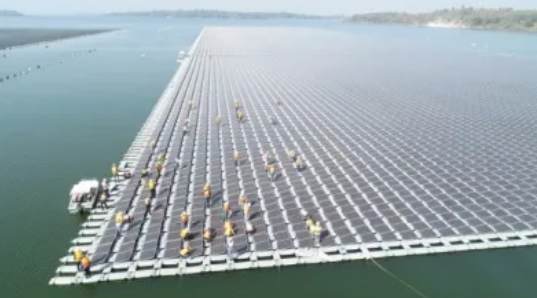
It has identified 7 locations for the pilot phase, selecting prominent reservoirs such as Mettur dam, Bhavanisagar dam, Vaigai dam, Red Hills reservoir, and Sathanur dam, along with a TNGECL-owned site at Avalanche lake
Chennai
In a major push toward renewable energy, Tamil Nadu Green Energy Corporation Limited (TNGECL) has unveiled plans to develop floating solar photovoltaic projects across key reservoirs in Tamil Nadu.
The initiative aims to overcome land constraints for traditional solar parks while accelerating the state’s transition to sustainable energy sources.
The corporation has identified seven locations for the pilot phase, selecting prominent reservoirs such as Mettur Dam, Bhavanisagar Dam, Vaigai Dam, Red Hills Reservoir, and Sathanur Dam, along with a TNGECL-owned site at Avalanche Lake. These sites were chosen based on their water availability, size, and feasibility for hosting floating solar infrastructure.
Officials confirmed that TNGECL has initiated discussions with the Water Resources Department to secure necessary approvals for utilizing these waterbodies. At the same time, a private firm has been engaged to conduct feasibility studies focusing on technical viability, environmental impact, and integration of advanced systems such as battery energy storage. The project announcement is expected after the withdrawal of the election-related Model Code of Conduct.
According to TNGECL estimates, Tamil Nadu holds an untapped floating solar potential of nearly 3,000 MW across 57 reservoirs. The initial pilot phase is expected to generate around 100 MW, serving as a benchmark for scaling up similar projects across the state. The feasibility assessment will also examine factors like reservoir depth, cost structures, and site suitability to ensure efficient implementation.
While floating solar projects typically require about 20 percent higher investment compared to ground-mounted systems, they offer long-term economic and environmental benefits. The estimated cost ranges between ₹5 crore and ₹6 crore per MW, with each unit requiring approximately 3.5 acres of water surface due to additional floating infrastructure. Despite the higher upfront expenditure, officials believe the initiative could significantly reduce reliance on coal-based power generation. Over the next five years, the state could potentially save between ₹10,000 crore and ₹15,000 crore, reinforcing its position as a leader in clean energy adoption and sustainable infrastructure development.