


Intro: ‘It would undermine people’s rights and weaken the country’s long-standing cultural and religious diversity’
Kolkata
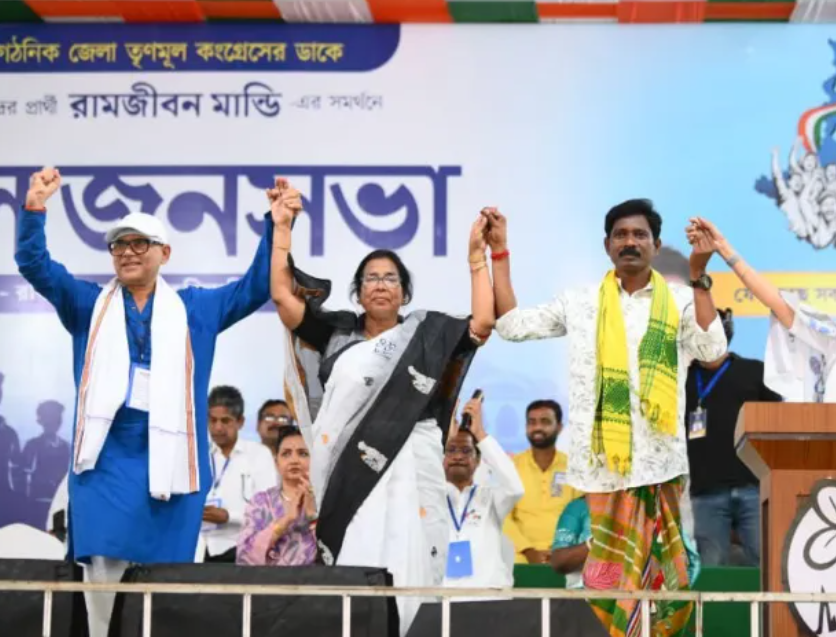
West Bengal Chief Minister Mamata Banerjee on Saturday strongly criticised the Bharatiya Janata Party’s proposal to implement a Uniform Civil Code (UCC) in the state, alleging that it would undermine people’s rights and weaken the country’s long-standing cultural and religious diversity.
Addressing a public rally in Keshiary in West Midnapore district, Banerjee voiced sharp opposition to the proposed Uniform Civil Code, warning that such a move could restrict citizens’ freedom to practice their religion according to their customs and traditions. She emphasised that India is a diverse nation where different communities follow distinct personal laws, particularly in matters such as marriage, inheritance, and social customs.
Highlighting this diversity, Banerjee pointed out that Hindus, Scheduled Castes, tribal communities, minorities, and Christians each adhere to their own religious practices and traditions. She argued that imposing a single code would disregard these differences and impose uniformity on a society built on pluralism. According to her, respecting diversity is essential to preserving the country’s social fabric.
The Trinamool Congress supremo further alleged that the BJP’s push for UCC reflects an attempt to centralise authority over cultural and social practices. She warned that such a policy could extend beyond personal laws and potentially impact education, traditions, and community identity. Urging voters to reflect carefully, she claimed that the proposal could lead to a loss of individual freedoms and cultural autonomy.
Her remarks came a day after Union Home Minister Amit Shah announced the BJP’s intention to implement the Uniform Civil Code in West Bengal while unveiling the party’s ‘Sankalp Patra’ for the upcoming Assembly elections.
The issue has quickly emerged as a major political flashpoint in the state. While the BJP maintains that a Uniform Civil Code would ensure equality before the law and eliminate discriminatory practices, opposition parties argue that it could undermine minority rights and India’s pluralistic ethos.
As campaigning intensifies ahead of the elections, the debate over UCC is expected to remain central to political discourse, with both sides using it to mobilise support and shape voter opinion across West Bengal.