


Kathmandu
The Bhote Koshi River valley catastrophe along the Nepal-China (Tibet) border is one of the most devastating cascading mountain hazards recorded in the region.
Wednesday, August 26, 2026, a massive glacial collapse and ice-rock avalanche high in the Himalayas triggered an inland “tsunami of dirt”. A colossal mass of ice and rock broke away from a glacier on the Tibetan side, falling roughly 1,200 meters to the valley floor.
The force of the initial impact was so immense that seismic monitoring equipment initially registered it as a magnitude 4.4 to 5.2 earthquake before scientists confirmed it was entirely gravity-driven.
Lhende Khola river (a primary tributary of the Bhote Koshi). Within minutes, the impounded water and melting ice breached this unstable natural dam, releasing a catastrophic, fast-moving surge downstream.
170 kilometers down the valley floor, water levels in the downstream Trishuli river system rose by 7 to 9 meters in less than 30 minutes, carrying colossal boulders, mud, and ripped-up trees.
The disaster directly struck a major transport, trade, and tourism corridor between Kathmandu and Lhasa. Over 332 people are confirmed dead, and more than 1,300 remain missing across both sides of the border.
As the valley is heavily frequented by trekkers and pilgrims, hndreds of missing individuals are foreign tourists from countries including India, the United States, Australia, the United Kingdom, and Malaysia.
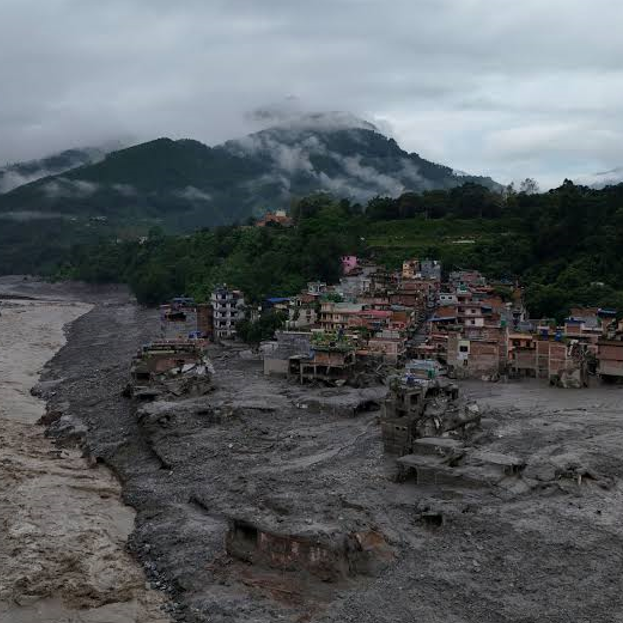
Entire villages, market areas, highways, and bridges were completely swallowed by mud. Crucial border infrastructure at Gyirong Port was severely crippled by a massive multi-story mudslide. Downstream hydroelectric plants and border outposts were also destroyed.
Emergency operations face massive challenges as roads have been severed and narrow river gorges are choked with several meters of thick sludge.
Entire villages, market areas, highways, and bridges were completely swallowed by mud. The Nepal Army and Chinese emergency teams have deployed helicopters and rescue vessels. Prime Minister Narendra Modi has also coordinated with Nepal to provide immediate humanitarian assistance as downstream regions in India brace for shifting river swells.Scientists point out that while the exact geological triggers take time to study, the destabilization of Himalayan glaciers is accelerating rapidly due to global climate change, leaving steep mountain valleys increasingly vulnerable to these unannounced, catastrophic failures.