


CH NEWS, BENGALURU
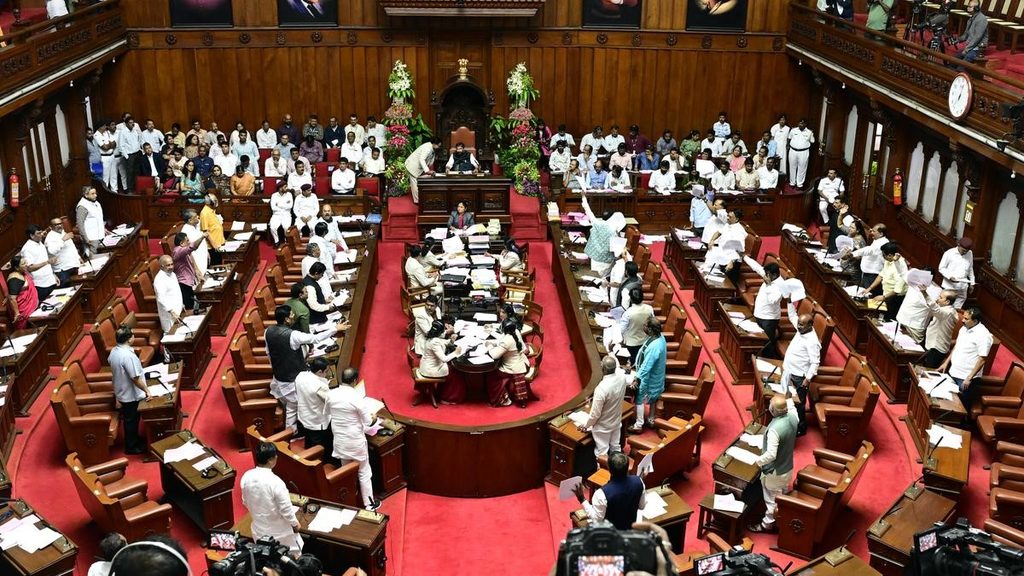
Intense friction dominated the opening moments of the special legislative session in the Karnataka Legislative Council as opposition members launched a scathing critique of the treasury benches over the conspicuous absence of cabinet ministers during a critical debate on the state’s escalating agrarian crisis.
As the House convened to address mounting rural distress, opposition legislators, led by prominent voices including C.T. Ravi, Bhoje Gowda, and Ravikumar, pointedly drew attention to the empty ministerial seats across the assembly. Highlighting the stark discrepancy between the gravity of the emergency and the government’s apparent indifference, opposition leaders remarked sarefully that there was an administrative “drought of ministers” inside the chamber, noting that only three out of the expected fifteen cabinet members bothered to be present for the opening deliberations.
The protest forced the Chair into a defensive posture, prompting the Chairman to formally assure the House that absent ministers would be summoned back immediately to face accountability. However, tensions escalated further as individual members attempted to pivot the floor proceedings toward auxiliary political controversies, such as regional language debates. The Chair firmly deflected these attempts, ruling that the special three-day assembly format was strictly mandated for two core state emergencies: formulating a definitive legislative consensus on the controversial Kasturirangan Report and addressing the unprecedented drought.
Taking the floor to table the formal motion on the agricultural crisis, Deputy Chief Minister and Revenue Minister G. Parameshwara delivered a sobering assessment of Karnataka’s environmental reality, characterizing the ongoing crisis as an exceptional catastrophe. Parameshwara informed the legislature that the state is currently enduring an intense weather anomaly driven by a devastating “Super El Nino” global climate phenomenon, which has critically disrupted regional monsoon patterns.
Detailing the statistical scale of the breakdown, the Deputy Chief Minister revealed that Karnataka typically records an aggregate annual rainfall benchmark of 852 millimeters, but has registered a mere 642 millimeters thus far, translating to an alarming cumulative state-wide deficit exceeding percent since June. Drawing grim historical parallels, Parameshwara warned that the ongoing meteorological deficit and its devastating impact on agricultural sowing operations mirror the historical, catastrophic drought conditions last witnessed nearly a century and a half ago during the famine year of 1876.
Providing an update on relief classifications, Parameshwara stated that the government has systematically expanded its administrative safety net in phased increments. Following initial notifications covering 101 taluks and a subsequent addition of 23 regions, the administration has formally incorporated an additional 53 drought-hit zones, elevating the state’s total tally of officially designated calamity areas to 177 taluks. Furthermore, he indicated that ongoing field assessments and revenue surveys will likely push the count up by roughly 20 more districts, ultimately bringing approximately 200 taluks under the official drought umbrella.