


CH NEWS, BENGALURU
The political landscape in Karnataka is gearing up for a major structural shakeup. Karnataka Pradesh Congress Committee President B.K. Hariprasad has officially announced that a high-level Political Affairs Committee will be established in the state very soon. This crucial panel aims to bridge any communication gaps and create seamless coordination between the ruling party organization and the state government machinery.
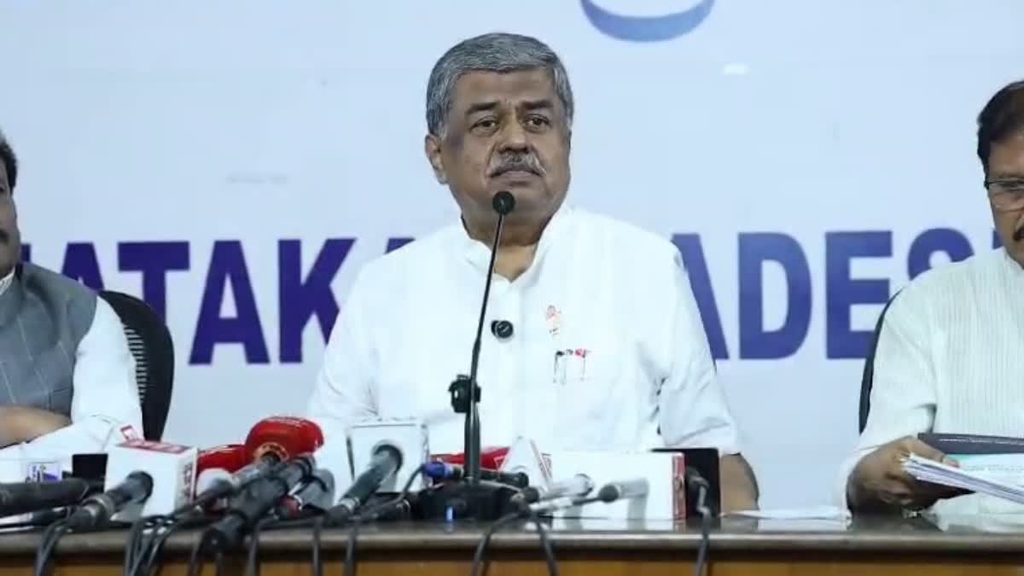
Addressing media persons near the party headquarters, Hariprasad revealed that senior national leaders K.C. Venugopal and R.Surjewala recently visited the state and issued explicit directives to expedite this initiative. “We are already making active preparations. I have personally consulted various senior leaders to gather their valuable inputs and suggestions. A final decision will be finalized shortly,” he stated.
Transitioning to cultural matters, Hariprasad warmly welcomed the recent state cabinet decision regarding regional languages. He lauded the move to elevate Tulu and Kodava, noting that Tulu carries a rich literary legacy deeply tied to Jnanpith laureates. He criticized those attempting to politicize linguistic identity without understanding historical contexts.
The KPCC chief also launched a fierce verbal attack on Prime Minister Narendra Modi. Mocking recent political rhetoric, Hariprasad questioned the Prime Minister’s focus on personal and social matters, asking why an unmarried leader frequently comments on issues like Triple Talaq. Furthermore, he accused the central administration of selling vital public sector undertakings established by past Congress governments, ranging from the tenure of Jawaharlal Nehru to P.V. Narasimha Rao. He contrasted this with his own administrative experience as Gujarat party in-charge, alleging that governance under the current leadership has disproportionately favored corporate giants while neglecting the daily struggles of ordinary laborers, workers, and common citizens.
Concluding his address, Hariprasad expressed deep concern over the growing intersection of religion and politics across the nation. He argued that personal faith should remain a private matter practiced inside homes, temples, churches, mosques, and prayer halls. He strongly condemned political elements for exploiting religious sentiments among the youth, urging citizens to focus on constructive social reform, economic progress, and the genuine upliftment of marginalized communities rather than falling prey to divisive tactics.