


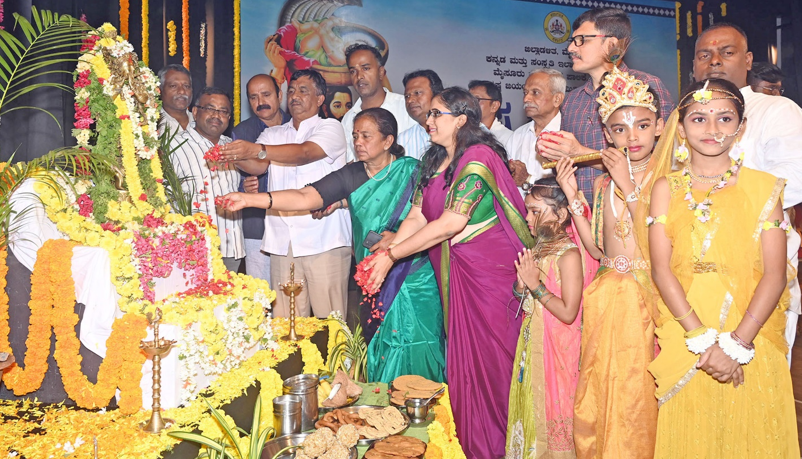
Mysuru:
Everyone living in Kaliyuga should know the Mahabharata to understand the conflict between dharma and adharma, said Legislative Council Member R. Raghu (Kautilya).
Presiding over the Sri Krishna Jayanti programme organised by the district administration, Department of Kannada and Culture, Mysuru City Corporation and Sri Krishna Jayanti Celebration Committee here on Friday, he said Lord Krishna, who was born as an incarnation of the Almighty, began conveying his message to the world even before his birth. As a child, he revealed his divine nature by showing the entire world in his mouth. “People should not become arrogant when they gain power and wealth, nor should they lose courage when they face difficulties and suffering,” he said.
Recounting an incident involving Bhima, he said that when Bhima asked Krishna for a one-line message that would apply equally to a person experiencing extreme happiness and one facing deep sorrow, Krishna wrote: “This too shall pass.” The message reminds people that wealth and power are not permanent, while also giving hope that even the most difficult situation will eventually come to an end, he said.
Raghu said the teachings and messages given by Lord Krishna to the world are unparalleled. If these values are made part of education, children will be encouraged to follow the right path.
He also highlighted the contribution of the Yadava community to Indian culture. The royal family that ruled the erstwhile Mysuru State belonged to the Yadu dynasty and made significant contributions to the region in areas such as water supply, healthcare, education, temples and spirituality. Though the Yadava community is smaller in number, it has always played an important role in religious and social matters and has worked as a guiding force for society. Creating awareness about the Mahabharata and Bhagavad Gita is the responsibility of everyone, he added.
Additional Deputy Commissioner R. Aishwarya said the famous Bhagavad Gita verse “Yada Yada Hi Dharmasya Glanir Bhavati Bharata” conveys the message that whenever adharma increases and dharma declines, the Almighty takes different forms in every age to protect the good and restore righteousness.
She said Krishna’s history and legacy remain alive in every part of India. She mentioned important Krishna pilgrimage centres such as Mathura, Gokul, Vrindavan, Barsana, Govardhan Giri and Dwarka in North India, as well as the Udupi Sri Krishna Temple in Karnataka and Jagannath Puri. Lord Krishna occupies a special place in Kannada literature, Dasa literature and poetry.
She referred to popular devotional compositions such as “Krishna Enabarade” and “Jagadoddharana Adisidalu Yashode”, as well as the works of poet K.S. Nissar Ahmed and Kumara Vyasa’s Bharata, which have inspired generations culturally.
Parents to teach their children at least one simple Bhagavad Gita shloka and its meaning in Kannada every day. “Understanding the true meaning and essence of the Bhagavad Gita and applying its teachings in life will make human birth meaningful. Introducing children to the principles of the Gita at an early age can positively change the way they look at life,” she said.
She stressed that passing on Indian culture and Krishna’s teachings to the younger generation is the responsibility of everyone.
Assistant Director of the Department of Kannada and Culture Dr. Sudarshan, writer Dr. Nagesh Yadav, Yadava Sangha Vice-President M. Venkatachala, Secretary Javaregowda, Rangaswamy, Pushpavalli and others were present.