


Mysuru
The state government has the responsibility of protecting government schools, as these institutions are essential for the upliftment of children from middle-class and economically weaker sections, said former Minister B. Somashekar.
Speaking after inaugurating a seminar on “Save Government Kannada Schools” and presenting the Dr. Sarvepalli Radhakrishnan Teacher Ratna Awards and Nannavva Seva Awards organised by Nannavva Cultural Art Troupe here on Tuesday, as part of Teachers’ Day celebrations, he said it should be the Government’s responsibility to open more Kannada-medium schools. The Government should take greater interest in establishing more government schools, particularly in rural areas. This would also provide women in rural communities and surrounding areas with better opportunities to pursue education.
The former minister said with the rapid increase in the number of English-medium private schools, people from lower-income groups are increasingly developing a mindset that they must send their children to private schools to learn English, even if it means borrowing money. As a result, several government Kannada schools are gradually being closed, which is a matter of great concern.
Somashekar stressed that the quality of teacher education at the primary-school level was extremely important. In the past, teachers who had completed TCH along with SSLC were appointed to primary schools. However, many of them did not possess adequate knowledge of important subjects such as science and mathematics after completing SSLC and becoming teachers. “Therefore, I had introduced a law making it mandatory for those seeking appointment as primary-school teachers to complete PUC,” he said.
He had fought strongly in the Assembly to bring about such legislation. If poor, socially disadvantaged and Dalit children were to receive quality education, teachers needed to possess adequate knowledge and skills. This would help students pursue higher education and build better futures.
The former minister recalled introducing the supplementary examination system to help rural students who were failing examinations in large numbers, and described the initiative as a social revolution, saying it had faced considerable opposition. “I insisted before the Chief Minister and succeeded in getting the legislation implemented. As a result, many students were able to appear for supplementary examinations and pass. Many of them have today gone on to occupy higher positions and are serving in responsible posts”.
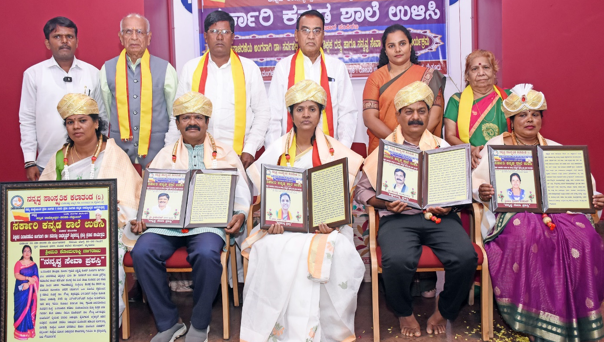
On the occasion, Suma, head teacher of Sadvidya School, and Shantappa, head teacher of the school at Srikanthapura on the forest fringe near Gundlupet border, were honoured with the Dr. Sarvepalli Radhakrishnan Teacher Ratna Award.
The Nannavva Seva Awards were presented to environmentalist Srikanthesh, Pratima Ramesh and Komalakshi Nagaraju in recognition of their service.
Dr. T. Padmashree, lecturer at the Dr. B.R. Ambedkar Research and Extension Centre; Suttur Gram Panchayat President G. Marahalli Rangaswamy; national award recipient Dr. N. Gangadharappa; trilingual poet and teacher Prabhashastri Joshyulu; and Nannavva Cultural Art Troupe president Yachenahalli Mahadev were among those present.