


BENGALURU
Urban mobility and pedestrian safety have taken center stage in local governance battles as municipal authorities push forward with aggressive public space reclamation efforts. Balancing the livelihood rights of street vendors against the daily safety of commuters has long tested municipal administration, prompting intense legal challenges over the execution of public clearance operations across crowded metropolitan thoroughfares.
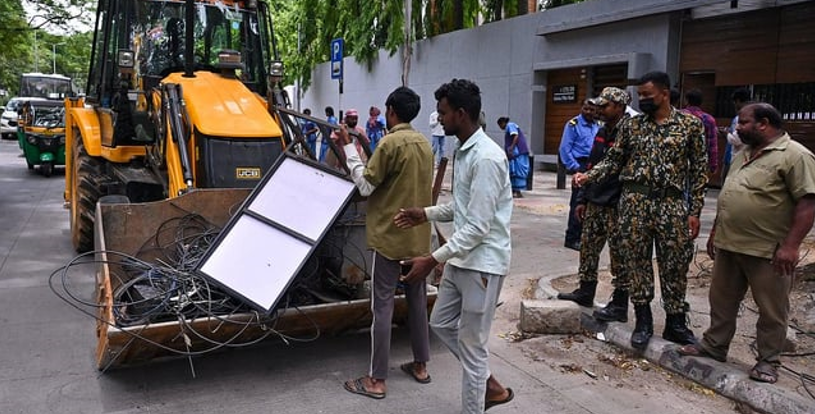
The Karnataka High Court has firmly refused to issue an interim stay against the ongoing “safe footpath” campaign launched by the Greater Bengaluru Authority (GBA). Presiding over a Public Interest Litigation (PIL) filed by prominent urban expert R. Rajagopalan, a division bench comprising Chief Justice Vibhu Bhakru and Justice K.S. Hemalekha ruled that there were no valid legal grounds to halt the municipal demolition and clearance drive.
The judicial bench emphasized that pedestrians possess an absolute right to navigate safe, unobstructed footpaths without encountering artificial hazards or blockages. The court noted that ensuring adequate walking space on urban roads is a fundamental necessity that justifies the administration’s ongoing enforcement measures.
During the proceedings, the petitioner argued that the GBA’s campaign was being implemented in a chaotic, disorganized manner devoid of transparent management protocols. Criticizing the lack of clarity regarding the operational scope, clearance methods, and post-clearance rehabilitation steps for displaced vendors, the petitioner urged the court to intervene and freeze the drive.
Rejecting the plea for a complete stay, the High Court clarified that its order upholds the core principle of maintaining clear, accessible walkways for the public. However, the bench adjourned the matter for further consideration while the clearance drive moves ahead.
The underlying legal challenge stems from opposition to the GBA’s sweeping anti-encroachment drive, which commenced on July 1, 2026, across five municipal corporation zones under its jurisdiction. Petitioners had previously demanded an immediate halt to the evictions, calling for strict compliance with the Street Vendors Act and the formulation of a structured Karnataka street vendor scheme. They urged the establishment of functional Town Vending Committees and the construction of designated trading centers within strict timelines to accommodate displaced vendors lawfully.
Despite strong protests from street vendor associations, municipal authorities continue their operations to reclaim public walkways. The court’s refusal to halt the campaign reinforces the administration’s mandate to prioritize pedestrian accessibility, even as debates persist over balancing municipal enforcement with the livelihood protections of informal urban workers.